The Libbey Flare 16-Piece Set: Tumbler and Rocks Glasses Built to Outlast the Occasion
It is 3 p.m. on the Saturday of the annual block party, and you have promised to bring the drinks. You open the cabinet above the sink, expecting the usual stack of clean tumblers. Instead, you find a disassembled picture: two cloudy tumblers, one rocks glass with a tiny chip, and a pile of mismatched cups from every fast-food place in town. You count them twice, and the total still does not reach sixteen. Fifteen minutes later, you are still standing there, considering whether to run a quick dishwasher cycle or simply apologize for the plastic cups. The hostesses always say no one cares about the glassware, but you know better—the right glass makes a drink feel like a gesture, not a delivery. What you need is a set you can stop thinking about, one that is always ready and always enough.
The Night the Glasses Ran Out
You are an hour from guests arriving, and the drink tray is the last thing on your list. You open the cabinet, count the tumblers, count the rocks glasses, and realize that the set you bought on sale three summers ago has surrendered two cracked rims and a chipped base to the dishwasher. For a moment, you consider the stack of paper cups behind the coffee maker. That hesitation—the quiet letdown of discovering your glassware is not up to the occasion—is the real reason a 16-piece set like the Libbey Flare earns its place on your table before the first guest walks in. It is not about having enough glasses. It is about having glasses you do not have to worry about, glasses that feel appropriate for a celebration rather than a compromise. Every gathering has a moment when the table is set, the food is ready, and the only thing between you and a smooth evening is whether the glass in your guest's hand feels like an afterthought or like part of the plan.
This is where Libbey's own words become useful. On its website, the company frames its tableware as something more than dishware: it is about setting the table for life's great moments, and it backs that promise with a history that reaches back to 1818. That founding year is not a trivia point; it is the beginning of a cause-and-effect chain that ends with a glass you can hand to a guest without wincing. Libbey has been making tabletop glassware for over two hundred years, and it describes its products as 'made to last'—a phrase that carries weight when you know the same company supplies the foodservice professionals who put glass through commercial dishwashers, bar back counters, and patio tables every single day. The Flare set inherits that pedigree, which means the 16 pieces in your cabinet are not the same as a generic 16-piece set from an unknown brand. They come from a maker that has been thinking about how glass survives real life longer than most countries have existed. When you read 'durable enough to withstand the busiest bars and wildest backyard barbecues,' that is not marketing fluff; it is a description of the conditions Libbey has been engineering for since the early nineteenth century.
Two Centuries of Glassmaking Still Matters
Two centuries of glassmaking matters because durability is not a single feature; it is the accumulated result of thousands of small engineering decisions. Libbey's own mission statement, posted for anyone to read, says that since 1818 it has been providing 'the finest tableware for the makers of drinks, the makers of meals and the makers of memories.' That sentence is easy to skim past, but consider what it takes to still be in business after 200 years of bars, diners, caterers, and home kitchens. That mission reinforces a 200-year history and a purpose; it is not a claim about one glass, but about a system. A company that has survived that long has faced every kind of failure mode a drinking glass can have—thermal shock, rim chips, cloudy film, broken stems—and has had to solve each one repeatedly for customers who do not tolerate shattering in front of guests. That institutional memory is exactly what you are buying when you choose a Flare set. The glassmaker has already made the mistakes so that your table does not have to.
Now trace what that experience actually produces. The Flare set gains its character not from a single secret material but from the way the glass is proportioned and finished. A tumbler that feels right in the hand has a wall thickness that is not so thin that it feels disposable and not so thick that it turns into a clunky weight; a rocks glass needs a base that stays put on an outdoor table when someone sets it down with a little too much enthusiasm. This is the effect side of the cause-and-effect chain: because Libbey has spent 200 years learning how commercial customers abuse glassware, the home version of that knowledge comes through as a set that simply behaves. Glasses stack cleanly, rims survive the refrigerator, and the clarity holds up after years of dishwasher cycles. None of this shows up in a spec sheet; you notice it only in the absence of annoyance, in the fact that you stop thinking about your glassware altogether. That is the real effect of durable engineering: it makes itself invisible.
What Separates a Glass You Keep from One You Toss
So what should you look for when you pick up a tumbler or rocks glass? Start with the rim. Run your finger around the lip; any graininess or irregularity is a sign that the glass will chip at the first contact with a metal spoon or the edge of a sink. Next, heft it. A glass that feels too light often uses thin walls that compromise durability, while a glass that feels too heavy may be hard to balance in hand. Then hold it to the light. Look for bubbles, seams, or waviness in the glass; clarity is not just cosmetic, because internal flaws are stress points where cracks begin. Finally, consider the base. A flat, stable bottom matters more than you might think, especially on outdoor tables where a slight slope can send a full glass sliding. These are the criteria that separate a glass you keep for years from one you relegate to the back of the cabinet. Notice that none of them appears on a product page; you have to develop the habit of inspecting glassware the way you would inspect a tool you plan to use for a decade.
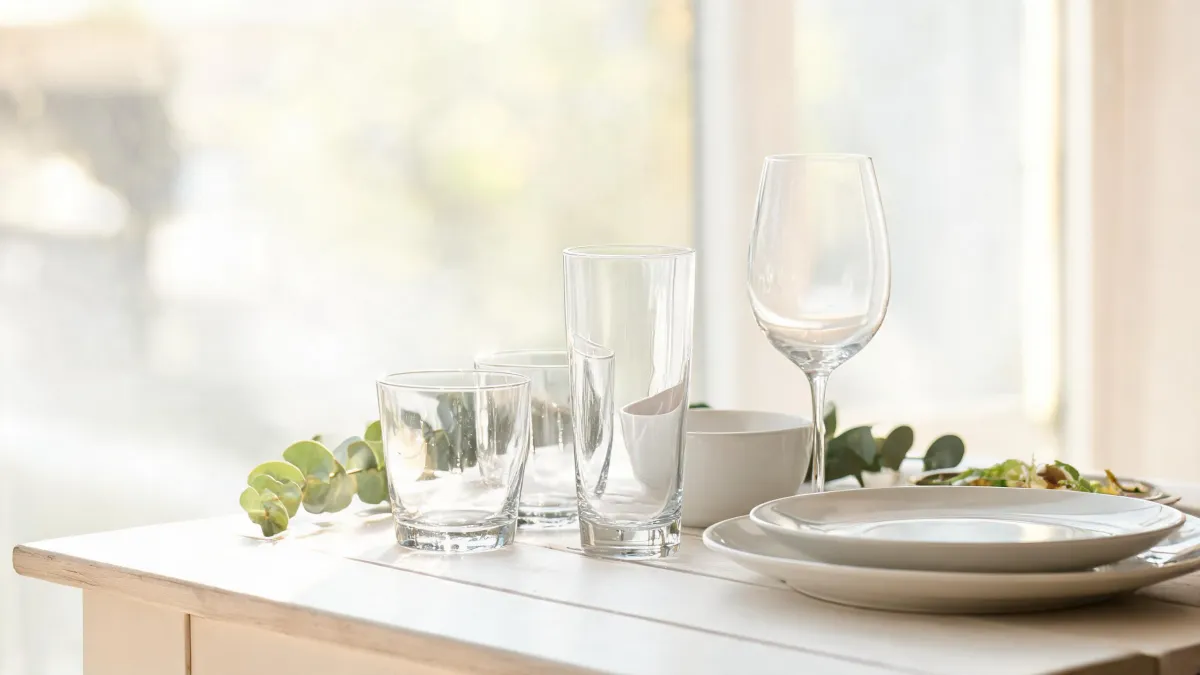
Apply that checklist to the Libbey Flare set and you will understand why it works for the full range of home occasions. The 16 pieces are configured, as most sets of this kind are, as eight tumblers and eight rocks glasses, which means you can pour a tall iced tea for one guest and a neat bourbon for another without pulling out two different collections. The tumbler is tall enough to hold a generous drink and the rocks glass is short enough to feel substantial in the hand on the patio. For a backyard barbecue, that mix covers both the mint julep crowd and the sparkling water crowd, and the set's durability means you can let guests serve themselves rather than policing who gets the good glass. And when the party moves inside, the same glasses do double duty at weeknight dinners, because a well-designed set does not look out of place next to a home-cooked meal. The key is that these are not special-occasion glasses you protect; they are everyday glasses that happen to be good enough for special occasions.
The Real Cost of Cheap Glass
The hard part is that cheaper sets pull at you in the store. A 16-piece set from an unknown brand can cost half as much, and the glasses look fine on the shelf. But the Libbey evidence reframes the comparison. The same source that talks about setting the table for life's great moments also points out that Libbey tabletop solutions are 'a top choice for foodservice professionals and home entertainers alike.' That phrase is the tiebreaker. Foodservice professionals buy glass every week from vendors who are graded on breakage; they do not stick with a brand for 200 years because of a logo. They stick with Libbey because, as the evidence says, the products are 'durable enough to withstand the busiest bars and wildest backyard barbecues.' A cheaper set may survive the first few parties, but its true cost shows up when a guest goes to clink glasses and the rim shears off. The hidden price of cheap glass is not the sticker; it is the moment you are left holding broken pieces in front of people you invited to relax.
So the decision rule is not 'buy the most expensive glass you can find.' It is 'calculate the cost per serving.' A cheap 16-piece set might cost $20, but if two glasses chip in the first year and you replace them with a slightly better set, you have already spent more in time and money than a durable set would have cost in the first place. The Libbey Flare set sits at a price point that treats it as a medium-term investment, not a luxury splurge. When you divide its price by the hundreds of gatherings it will serve, the per-occasion cost becomes trivial. The rule is simple: if you entertain more than a few times a year, buy glassware that does not plan to retire early. Ask yourself whether the glass in your hand will still be there after the third summer of backyard parties. If the answer is not an immediate yes, keep looking.
Back to the Table
Now bring it back to the scene from the opening. The hour is the same; the guests are the same; the cabinet is the same. Only this time, when you reach for a glass, your fingers close around a rim that has survived a hundred similar nights. The 16-piece Flare set is there because you decided that the moment of handing someone a glass is not a place to gamble. You set out eight tumblers for the iced tea and eight rocks glasses for the bourbon, and you do not flinch when someone sets a glass down hard on the stone table. The evening unfolds without a trip to the recycling bin, without a whispered apology about the chipped set, without anyone having to drink from a plastic cup. That is the quiet victory of choosing glassware that is 'made to last': the gathering gets to be about the people, not about the stuff.
Here is the rule you can reuse the next time you are tempted by a cheap set or paralyzed by an expensive one: buy the glass you would not mind replacing ten years from now. That is the standard Libbey has been meeting since 1818. A tumbler that still sits level, a rocks glass that still rings when you clink it, a set that still looks like a set after a decade of parties—that is not an aesthetic indulgence. It is the most practical thing you can put on a table. When you choose a 16-piece set that was engineered for the busiest bars, you are not just buying glasses; you are buying the certainty that the next gathering will not be remembered for the broken one. And that, in a single sentence, is why the Flare set earns its place: it is not the most glamorous purchase you will make, but it is the one you will never have to make again.
When a glass survives a decade of parties, the decision to buy it was never really about glass.

Ingrid Falk
Ingrid Falk is an outdoor living products analyst specializing in fences, pergolas, gazebos, canopies, greenhouses, shade sails, patio sets, outdoor sofas, and weatherproof cushions. She uses ISO 4892-2 and ASTM G154 weathering methods while comparing UV color change, coating adhesion, corrosion resistance, frame load, joint stability, water shedding, and dimensional movement. Her work helps garden retailers, project buyers, and hospitality operators select structures and furniture suited to wind exposure, climate, installation method, maintenance, and expected occupancy.
Leave a Reply