Libbey Flare 16-Piece Tumbler and Rocks Glass Set: A Field Guide to Everyday Durability
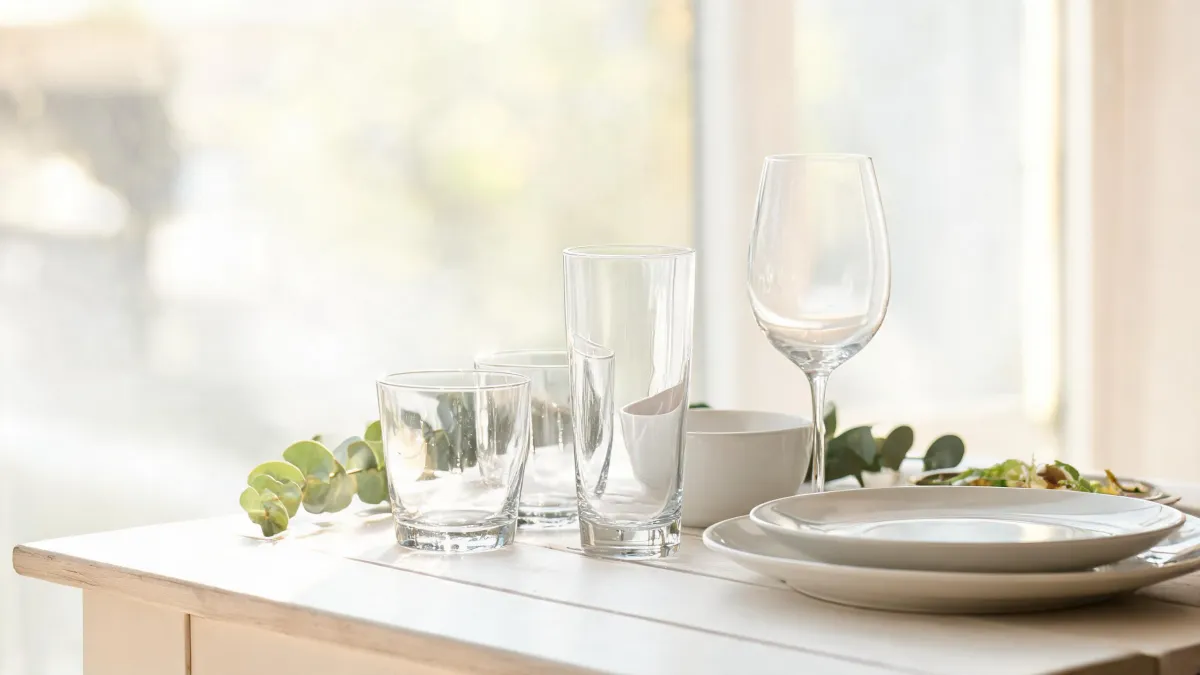
You've just sliced through the tape on the shipping box, and the Libbey Flare 16-piece set is suddenly on your kitchen counter: eight tumblers and eight rocks glasses, all catching the afternoon light. They feel substantial in a way that cheap glass doesn't, but you're not yet sure whether that weight is style or substance. Before you pour the first drink, the question that matters is whether this glassware can survive the life you actually live—weekday dinners, backyard grilling, and the inevitable knock of a busy table.
Unpacking the Libbey Flare 16-Piece Set: First Impressions
The 16-piece composition is the first thing you notice: eight tumblers for everyday water and juice, eight rocks glasses for the evening pour. Stacked on the counter, they take up less space than you'd expect, and the slight flaring at the rim makes each one easy to grip. Run your finger around the edge and you'll feel a clean, finished line that suggests care in the making. The glass is clear enough to read a label through, but it has a bit of heft—not fragile, not clunky. Yet a first impression only goes so far. The real test isn't how they look in the box—it's whether they'll look the same after a season of family meals, cookouts, and the odd knock against a faucet. That's the question this guide is built to answer.
That question carries more weight once you learn where the set comes from. Libbey has been making tableware since 1818, which puts the company at just over 200 years in the business of producing glasses, mugs, and barware. A two-century history doesn't guarantee that any single product is durable, but it does change how you read the phrase 'made to last' on the packaging. The brand's own materials describe a mission centered on the people who pour drinks, cook meals, and gather around a table—and that framing suggests durability is not an afterthought but a design requirement. When a company has spent 200 years figuring out how to make glass that survives commercial bars and family kitchens alike, its entry-level set carries more engineering than the label implies.
That heritage narrative could easily be marketing fluff, but it points to something tangible in the glass itself. The reason Libbey has survived two centuries isn't that it makes the most delicate crystal—it's that it learned how to produce serviceable, hard-wearing glassware at a scale that restaurants and bars trust. You can see that logic in the Flare set's proportions: the bases are wide enough to feel stable, the walls are thick enough to absorb minor impacts, and the rims are reinforced rather than feathered. None of this is visible in a product photo; it only appears when you handle the glass and think about how it was made. So before we talk about where these cups belong in your cabinet, it's worth spending a moment on the process that makes them last.
Two Centuries of Made-to-Last Glassmaking
The Libbey story begins in 1818, in a glassworks that would outlive countless competitors by focusing on what working establishments actually need. The company's own pages repeat the same promise—'Made to Last'—and ground that promise in a 200-year record of supplying the foodservice industry. That's not a slogan painted on a warehouse wall; it's a standard that has been tested by generations of bartenders who expect a glass to survive a busy Friday night and a family that expects the same glass to survive a birthday party. The evidence in Libbey's public materials consistently pairs the founding date with the durability claim, as if the two are inseparable. The mission statement, repeated across its pages, centers on serving those who make drinks and meals and memories—and that mission makes sense only if the tableware endures the moments it serves. Read carefully, the emphasis is less on elegance and more on endurance.
The most concrete statement of that durability comes from a line in Libbey's official materials: the products are 'durable enough to withstand the busiest bars and wildest backyard barbecues.' Notice what that sentence does. It doesn't say 'fine china for special occasions' or 'delicate glass for polite company.' It deliberately names the two most punishing environments for glassware—a commercial bar where glasses are handled rapidly, stacked, and occasionally dropped, and a backyard barbecue where the terrain is uneven and the hands are busy with tongs and plates. That single claim reframes the Flare set from a tabletop accessory into a piece of everyday equipment. It also tells you something about the manufacturing: the glass has to be annealed properly, with internal stresses reduced so that chips and cracks don't spread easily. You can't fake that with a thicker-looking rim; it comes from process control.
The cause-and-effect chain here is worth spelling out. A 200-year-old company has had time to refine its formulas and firing schedules, and that experience shows up as consistent wall thickness and a balanced distribution of weight. When a glass is made quickly and badly, it may look fine on day one but develop stress fractures after a few trips through the dishwasher. Libbey's approach, shaped by decades of commercial feedback, is designed to avoid that slow failure. The practical result is that you can treat the Flare set as you would treat a good cast-iron pan: it rewards normal use and shrugs off the occasional careless knock. That's the underlying reason these glasses can move seamlessly from a Tuesday dinner to a Saturday cookout—they're built for the wear, not just the look.
From Weekday Dinners to Backyard Barbecues: Where Flare Earns Its Place
Consider what a normal week actually demands from a drinking glass. Monday morning it holds orange juice and gets hurried into the dishwasher with half-congealed oatmeal on the plate beside it. Wednesday evening it sits on a crowded table while someone reaches across for the salt; knuckles bump the rim. Saturday it gets stacked in a tall cupboard and retrieved with a quick tug that would dislodge a lighter cup. In all of these moments, the Flare tumbler behaves like a well-balanced tool. The slightly flared rim gives your fingers something to hold, the base is weighted enough to stay put on a wet counter, and the walls are clear but not brittle. For families, the 16-piece configuration means you can run a full table setting and still have a spare glass for the neighbor's kid who suddenly appears. None of that is glamorous, but it's the difference between glassware that lives in a cabinet and glassware that lives in the rotation.
The backyard barbecue is where a cheap glass reveals itself. A plastic tumbler feels flimsy and sweats onto the picnic table; a delicate crystal glass makes you nervous every time a child runs past. The Flare set was designed for a middle path, and Libbey's own evidence points directly at that setting: 'wildest backyard barbecues' is a strange phrase to invent if the product couldn't back it up. What makes a glass barbecue-proof isn't a single feature; it's a combination of heft, a stable base, and a rim that won't chip the first time you tap it against a grill grate. Because the material is soda-lime glass at a practical thickness, it can handle thermal swings from ice-cold lemonade to warm cider without cracking. That doesn't mean you should throw one like a baseball, but it does mean you can pass a full glass across a crowded patio without holding your breath.
The synthesis is straightforward: durability is what allows the Flare set to be present at the moments Libbey says it's for. Their marketing language talks about gathering friends and family to share a meal and creating memories—but memories don't form when you're worried about replacing the good glasses. Because the Flare set is tough enough for everyday use, it earns a permanent place on the table instead of being reserved for special occasions. That changes the psychology of hosting: you can focus on the people and the food, not on the glassware. In that sense, the brand's evidence about memories isn't soft sentiment; it's a direct consequence of a mechanical property. The set can anchor a memory because it survives the moment.
How to Decide: A Simple Rule for Choosing Your Everyday Glassware
So how do you decide if the Libbey Flare 16-piece set deserves a spot in your kitchen? The rule I tend to use is simple: ask whether the glass will meet real use more than twice a week, and whether you care about the craftsmanship behind it. If both answers are yes, a set like this earns its place. The Flare set is not the cheapest glassware you can buy, and it's not the thinnest or most elegant. What it offers is a specific trade: a proven manufacturing heritage, a durable build, and a configuration that covers both daily water and evening drinks. If your household lives on a cycle of 'good glasses for guests' and 'cheap glasses for us,' this set collapses that division. If, on the other hand, you genuinely never host, never take a drink outside, and prefer ultra-light crystal for its elegance alone, the rule will point you somewhere else.
The evidence supports that rule. When Libbey says its products are durable enough for busy bars and backyard barbecues, it's giving you a boundary condition: this glass is designed for high-frequency, slightly rough use. That is exactly the condition of a family kitchen, not a display cabinet. The same sentence also implicitly tells you what the set is not: it's not a champagne coupe for sipping at a tasting, and it's not a hand-blown artisanal piece where every bubble is a signature. If you're in the market for that kind of glassware, Flare will feel too sturdy, too ordinary. But if your kitchen is a working space where glasses get picked up, stacked, washed, and occasionally bumped, then this evidence directly answers the decision: the set is built for your world.
It's worth being precise about the boundary, because the phrase 'everyday glassware' can mean different things. The Flare set is not for someone who drinks mineral water from a single-origin artisan tumbler and calls the whole thing a ritual. It's also not for a commercial bar looking for a shatterproof alternative to standard pint glasses—though it would get through a shift, the design priority is home use. The sweet spot is a household that wants one set of glasses that can do almost everything: juice in the morning, iced tea at lunch, a rocks pour at dinner, and lemonade outside with the kids. If that's your life, the Flare 16-piece set's simplicity is its strength. There's no pattern to match, no gold rim to worry about—just glass that's made to be used.
Back to the Table: Why This Set Earns Its Spot
Go back to the moment you first unpacked the set. The glasses are still on the counter, and now the afternoon has turned into early evening. The neighbors have arrived, the grill is smoking, and you're reaching for a tumbler to fill with iced tea for a guest. You notice that you didn't hesitate before picking it up—no second thought about whether this glass is 'nice enough' for company. That instinct is the real proof. The Flare set has already started to behave like the old, trusted pieces in your kitchen, the ones you grab without thinking because they've never given you a reason to be careful.
The verdict comes into focus when you connect the threads. Libbey's 200-year history and its 'Made to Last' promise are not just brand decoration; they show up in the way this glass carries itself. The company's own material turns a meal into a scene of making memories, and while that language is easy to dismiss, it lands differently when you've just passed a durable glass across a crowded table without worry. The Flare 16-piece set earns its spot because it quietly removes the friction from everyday hosting. It doesn't try to be the most beautiful object on the table; it tries to be the one you never think about. And in a world where most products ask for attention, a glass that simply endures—through dinners, parties, and the occasional knock—is what actually lets a table gather around it.
You put the glass down, and it lands with a solid, low note rather than a thin ping. That sound is a small summary of everything this guide has covered: a product built for contact with real life, carrying two centuries of know-how in something as simple as a tumbler. The Flare set won't sparkle like fine crystal, and it won't win an award for design innovation. What it will do is stay. And staying is what makes a glass, over time, become part of the table's story.
The tape is off, the first pour is done, and the glasses are back on the counter—ready for the next meal, the next guest, the next memory.

Ingrid Falk
Ingrid Falk is an outdoor living products analyst specializing in fences, pergolas, gazebos, canopies, greenhouses, shade sails, patio sets, outdoor sofas, and weatherproof cushions. She uses ISO 4892-2 and ASTM G154 weathering methods while comparing UV color change, coating adhesion, corrosion resistance, frame load, joint stability, water shedding, and dimensional movement. Her work helps garden retailers, project buyers, and hospitality operators select structures and furniture suited to wind exposure, climate, installation method, maintenance, and expected occupancy.
Leave a Reply